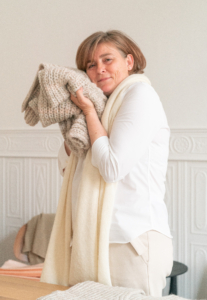
Some customers look at the price tag first and roll their eyes. Hold on, just a moment! The alpacas are sheared once a year. You can see their fleeces grow every day and after a year full of patience, they can be ‘harvested’.
The pure fiber of our Hug&Hum scarf
On large farms, there is a whole team ready with multiple shearers and assistants to bring the animals in, hold them during shearing, and take them back to the meadow/herd. In addition, there is also a team that sorts the fleeces for the first time. Then, the raw fleeces are brought to the spinning mill where they are thoroughly hand-sorted again for quality: fineness, length, softness, and color.
After that, they are washed, dried, pulled into slivers, spun, and wound onto cones, in hanks, or balls. Only then do we have a ‘thread’. Producing our own custom-blended yarn can take several months.
The Hug & Hum scarves consist of 100% baby alpaca, nothing synthetic, no chemical treatments, just the pure fiber. This pure yarn costs quite a bit more than yarns containing a portion of synthetic fiber.
How do we dye the scarf?
To have some extra color in the collection, some of our yarns are sent to a social dye studio, where the yarns are plant-dyed and where the women are well-guided and paid fairly. The plants are still hand-picked in the Andes mountains and go into the cooking pot together with the raw yarns, in an authentic way, until the right color is achieved.
Social knitting studio in Peru
After that, the yarns from the spinning mill and the dye studio can go to the social knitting studio.
The design process of Hug & Hum starts with the pure yarn. After choosing the yarns, the thickness, the type of yarn (e.g., brushed), the colors, and mélanges, test swatches are knitted from which the best stitches and color blends are retained. Only then is it determined which designs yield the best result. Designing means having ideas and brainstorming, doing this several times over, making decisions… doubting, adjusting until the collection is spot on.
The final designs are discussed with the studio's designer, and a first prototype is knitted, sometimes several, to also see the results in the different colors and mélanges. If the first prototype is not satisfactory, adjustments are made and a second prototype is knitted. If that still isn't quite right, final adjustments are made before production. This takes several more months.
A fair wage for the women in Peru
Each scarf is hand-knitted in a social knitting studio in Peru, where vulnerable women and their children are supported, where they learn to knit and receive a fair wage. Your scarf is knitted either with knitting needles or with a manual knitting machine and is made there stitch by stitch and piece by piece with a lot of love and craftsmanship. We do not participate in mass production.
Afterwards, a label is sewn in by hand, everything is cleaned neatly with a kind of dry cleaning, everything is folded and packaged. To get everything to Belgium, there is also the ‘trip’ from Peru to Belgium involved; the prototypes already preceded the production.
Marketing: that too
Marketing: if the ‘little creature’ is not known, it won’t be sold, so… Once the prototypes are ready, a photo shoot is organized because you have to be able to present the knitwear to your audience.
For the photo shoot, you need: a location (rent), a photographer, a videographer, a MUHA (make-up and hair artist), a stylist, and several models. Every look must be determined in advance, and a script for the photo shoot is also drawn up.
With the photos and videos, a marketing plan is developed: with Facebook ads and Instagram. Flyers and posters are printed. Everything is also neatly integrated into the online shop.
Once everything is ready, the producer can choose to sell through shops, an online shop, pop-ups, or events. That also adds to the price.
If you sell through shops, the retail price is the wholesale price x 2 or x 2.5.
If we, as the producer, sell directly via our online shop, pop-up, or events, the price can be kept lower. But creating an online shop also has its price.
With a pop-up, you also have to take into account rent, expenses, interior, sales staff…
A scarf with a story
And then, of course, there are the labels that need to be attached to the knitwear, such as the brand label and the care label, the hangtags, and a bag to take everything home or a box to ship in + shipping costs… Designing the labels also takes a lot of time.
Not to mention fixed costs such as: car, mobile phone, laptop, accounting…. And I might have forgotten a few things…
Can you still keep track of how many hands have worked on your scarf?
Some customers look at the price tag first, but once they have read this, they understand why. Their scarf has a story.
Do you want to support this project and purchase your scarf? Then go to https://www.hug-hum.be/collections/scarves
Enjoy your scarf. www.hug-hum.be
Warm regards, Anja